
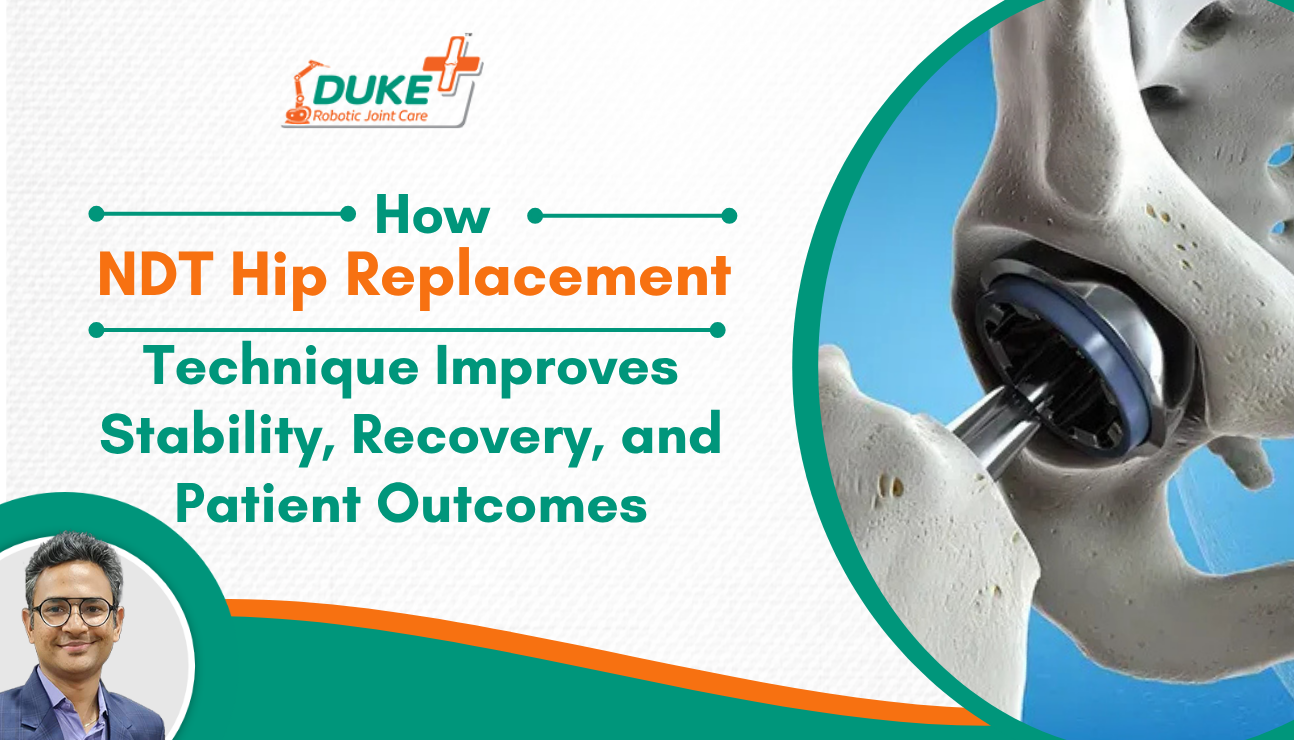
Hip replacement surgery has helped millions of people reclaim their mobility and live pain-free. But not all hip replacement techniques deliver the same results.
The NDT (No Dislocation Technique) is an advanced approach to hip replacement that is specifically designed to improve three things that matter most to patients — stability, recovery, and long-term outcomes.
If you or someone you know is considering Hip Replacement in Gujarat, understanding how NDT works — and why it delivers better results — could change the direction of your treatment entirely.
What Is NDT?
- NDT stands for No Dislocation Technique.
- In traditional hip replacement, the hip joint is dislocated during surgery to access the joint.
- NDT performs the entire procedure without dislocating the hip.
- This protects surrounding muscles, nerves, and soft tissue throughout the surgery.
- Result: a safer, more stable, and faster recovery for the patient.
Read more : NDT technique and its advantages for hip replacement patients.
How NDT Improves Stability
In traditional hip replacement, dislocating the hip during surgery causes significant damage to the muscles and soft tissue that naturally stabilise the joint. Once these stabilisers are disrupted, the risk of post-surgery dislocation increases — and recovery of natural stability takes much longer.
NDT changes this completely:
✔ The hip joint is never dislocated — so natural stabilisers remain intact.
✔ Surrounding muscles and ligaments are preserved throughout the procedure.
✔ The implant is placed with the natural stabilising structures still in position.
✔ Patients experience significantly greater joint stability from day one after surgery.
The result is a hip that feels stable, secure, and natural — because the structures that make it stable were never disturbed.
For patients considering Hip Replacement in Gujarat, stability after surgery is one of the most important factors in choosing the right technique.
How NDT Speeds Up Recovery
Recovery after traditional hip replacement can be long, painful, and restrictive. NDT changes the recovery experience significantly — and here is why:
- Smaller incision, less trauma
NDT requires a smaller surgical incision — meaning less disruption to surrounding tissue and a cleaner, more comfortable healing process.
- Preserved muscles = faster return of strength
By avoiding unnecessary muscle damage, NDT helps maintain natural hip function, allowing for quicker movement, improved stability, and a faster recovery journey.
- Walking within 24 to 48 hours
Most NDT patients begin walking the day after surgery — sometimes the same day. This early mobilisation is a key part of faster recovery.
- Shorter hospital stay
NDT patients are typically discharged within 2 to 3 days — much less than traditional hip replacement. Less time in hospital means faster return to the comfort of home and family.
- Less post-surgery pain
A smaller surgical impact means less pain during recovery. Patients require less pain medication and report a more comfortable overall healing experience.
- Structured physiotherapy supports recovery
Post-surgery physiotherapy plays a vital role in NDT recovery. With muscles already preserved, physiotherapy sessions are more effective and produce faster results.
NDT vs Traditional Hip Replacement — Outcome Comparison
| Traditional Hip Replacement | NDT Hip Replacement | |
| Dislocation risk | Higher | Significantly lower |
| Muscle damage | More | Significantly less |
| Recovery time | Longer | Faster |
| Post-surgery pain | More | Less |
| Stability after surgery | Lower | Higher |
| Long-term outcomes | Good | Better |
| Hospital stay | Longer | Shorter |
Why Duke Robotic Hospital for NDT Hip Replacement in Gujarat
Duke Robotic Hospital in Palanpur is a leading centre for advanced Hip Replacement in Gujarat, offering specialised orthopedic care, advanced surgical expertise, and patient-focused treatment.
- Dr. Bhupendra Patel — specialist in NDT hip replacement with extensive experience in joint-preserving and minimally invasive surgical techniques
- In-house physiotherapy support to help patients recover after surgery
- 24/7 patient care with continuous support throughout treatment and recovery
- Trusted by 25,000+ patients across Gujarat and beyond
Patients seeking advanced Hip Replacement in Gujarat travel from across the state and neighbouring regions to Duke Robotic Hospital for Dr. Bhupendra Patel’s expertise, advanced treatment approach, and compassionate patient care.
Conclusion
Choosing the right hip replacement technique isn’t just about relieving pain — it’s about regaining confidence in your movement, feeling safe with every step, and returning to the life you love without fear of complications.
NDT is a smarter, safer approach that protects your muscles, speeds up healing, and delivers lasting comfort.
If you are planning Hip Replacement in Gujarat, ask about NDT. At Duke Robotic Hospital, you get expert care, advanced technology, and a better outcome — all under one roof.