
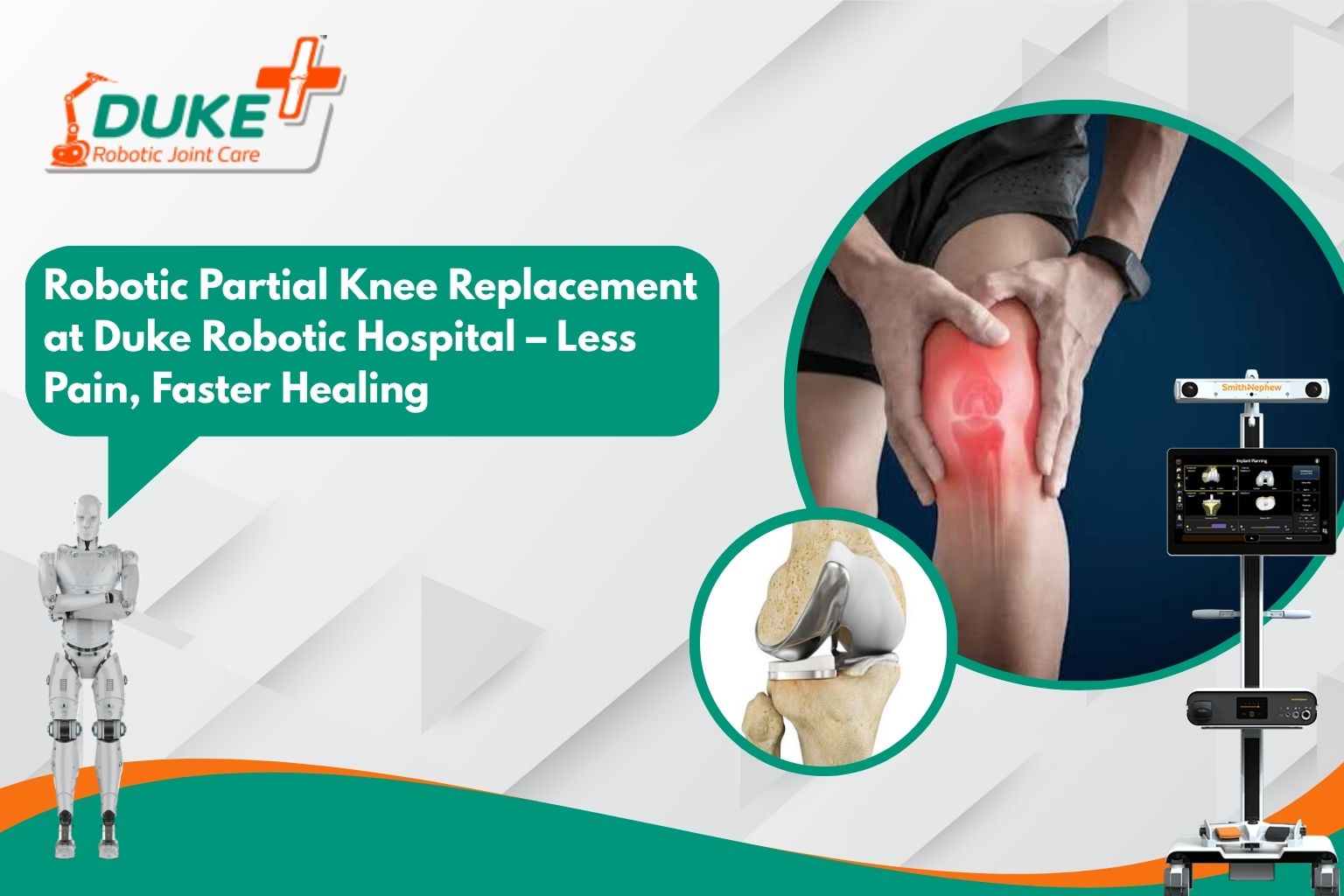
Preserving Healthy Tissue for a More Natural-Feeling
Partial knee replacement might be a better treatment option than replacing the entire joint when only a portion of the knee is worn or damaged. It allows the surgeon to remove only the affected area while saving healthy bone, cartilage, and ligaments. This helps preserve the knee’s natural shape and movement and often leads to a quicker, more comfortable recovery.
Robotic-assisted surgery makes it even better. Using advanced 3D mapping, high-definition scans, and real-time computer guidance, the surgeon can plan and perform the procedure with exceptional precision, ensuring the implant fits perfectly and functions as naturally as possible.
Why Robotic Technology Makes Knee Replacement More Precise
Robotic systems, such as the CORI Robotic technique used at Duke Robotic Hospital, provide real-time 3D mapping and surgical planning. This ensures that the implant is placed with proper precision. The result? Better alignment, improved balance, and less disruption to surrounding tissue. This level of accuracy is difficult to achieve with conventional tools alone.
Dr Bhupendra Patel, with his expertise in robotic-assisted joint surgeries, uses this advanced technology to deliver consistently precise and personalised outcomes for every patient.
Understanding Robotic Partial Knee Replacement Surgery
Robotic Partial Knee Replacement, also known as Oxiplasty technique, is a minimally invasive procedure designed for individuals with early or localised knee damage. Instead of replacing the entire joint, as done in total knee replacement, this approach focuses only on the worn-out section, conserving the healthy parts of your knee.
By keeping more of your natural joint intact, this technique often results in quicker recovery, reduced discomfort, and smoother joint function after surgery.
At Duke Robotic Hospital, the procedure is done by Dr Bhupendra Patel, a expert in robotic joint care and Oxiplasty. Using advanced robotic tools, our team ensures precision, safety, and comfort throughout the process, helping patients return to their normal routines with greater ease and confidence.
Partial vs. Total Knee Replacement: What’s the Difference?
Partial knee replacement targets just the damaged section of the knee, making it a less invasive option than total knee replacement, which replaces the whole joint. As a result, recovery is usually quicker, often 3 to 6 weeks compared to 6 to 12 weeks for total knee replacement—hospital stays are shorter, and there’s often less discomfort afterward. Partial replacement is generally ideal for early-stage arthritis, while total replacement suits more advanced conditions.
Explore Partial vs. Total Knee Replacement Surgery to see which option may be right for you.
Key Benefits of Robotic Partial Knee Replacement
Choosing robotic partial knee replacement at Duke Robotic Hospital comes with several advantages:
This approach is ideal for patients looking for a targeted, high-tech solution with shorter recovery time.
FAQ’s
Choosing the Right Surgeon for Partial Knee Replacement: The Secret to a Successful Surgery
Even with the most advanced tools, outcomes depend heavily on the surgeon’s experience. Choosing someone who understands both technology and joint-preserving techniques is key to getting the best results.
Dr Bhupendra Patel, a leading knee specialist at Duke Robotic Hospital, is trusted across Gujarat for his skill in partial knee surgeries. His patient-first approach, precise technique, and in-depth understanding of joint preservation make him a preferred choice for those seeking quality and long-term results.