
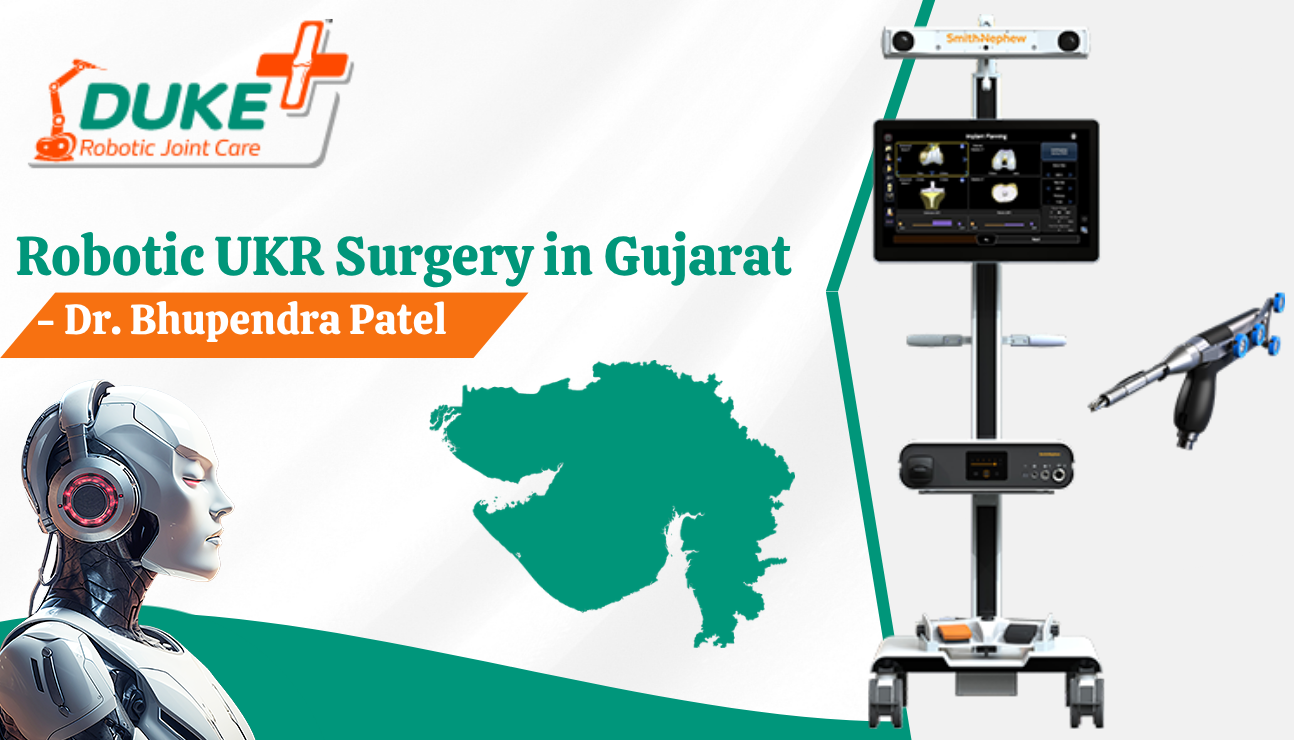
Knee pain can significantly affect your quality of life, especially when everyday movements become difficult. However, if the arthritis is confined to just one part of your knee, you may not need a total knee replacement — you may benefit from a less invasive option like robotic partial knee replacement.
With the rise of robotic technology in orthopaedics, patients in Gujarat now have access to advanced, minimally invasive treatments that deliver faster recovery and more natural movement. Here’s everything you need to know about Robotic UKR Surgery —and why more patients are choosing it.
What Is Robotic UKR (Unicompartmental Knee Replacement)?
Robotic UKR is a procedure of knee surgery where only the damaged portion of the knee joint is replaced, rather than the entire knee. It is most suitable for patients whose arthritis is confined to one compartment—typically the inner or medial side of the knee.
Unlike traditional surgery, robotic-assisted UKR uses real-time 3D mapping and high-precision tools to ensure perfect implant placement, preserving healthy bone, ligaments, and tissues.
Benefits of Robotic UKR Surgery
Robotic UKR is a game-changer for those eligible for partial knee replacement. Here’s why:
- Precision Placement: Robotic systems ensure the implant is positioned with sub-millimetre accuracy.
- Preservation of Healthy Tissue: Since only the damaged part is replaced, patients retain more of their natural knee structure.
- Smaller Incisions: Less invasive than total knee replacement, leading to faster healing.
- Faster Recovery: Many patients resume walking within days and return to active routines in a few weeks.
Why Robotic UKR Is Gaining Popularity in Gujarat
With rising awareness and better access to robotic technology, Robotic UKR Surgery In Gujarat is becoming a preferred choice. People from cities like Palanpur, Mehsana, Himatnagar, and even across state borders are now opting for this advanced surgical technique for partial knee arthritis.
Duke Robotic Hospital: Leading the Robotic UKR Revolution
Located in Palanpur, Duke Robotic Hospital is one of Gujarat’s first centres to introduce CORI-based robotic knee surgeries.
Under the leadership of Dr. Bhupendra Patel, the hospital has become a trusted name for robotic UKR knee replacement and advanced joint care.
With hundreds of successful robotic surgeries and an emphasis on patient-first care, Duke Robotic Hospital continues to attract individuals seeking reliable outcomes and quicker recoveries.
Dr. Bhupendra Patel – Robotic Unicondylar Knee Replacement Surgeon
As a leading UKR surgeon in Palanpur, Dr. Bhupendra Patel focuses on delivering precision-based outcomes through robotic-assisted techniques, ensuring faster recovery and more natural joint movement.
He offers specialised procedures including:
- Robotic Oxiplasty™
- Robotic Knee Microplasty
- TUKsplasty
With a strong commitment to patient-centric care and advanced surgical technology, Dr. Bhupendra Patel has made Duke Robotic Hospital a trusted centre for modern knee solutions.
When Could Robotic UKR Be Right for You?
If you’re dealing with knee arthritis that hasn’t improved with conservative treatments, robotic UKR (Unicompartmental Knee Replacement) may be an option worth exploring. It is generally considered in cases such as:
- Arthritis affecting only one part of the knee
- Pain during activities like walking, climbing stairs, or bending
- A stable knee joint with healthy ligaments
- When lifestyle changes, medications, or physiotherapy haven’t brought lasting relief
An evaluation by a specialist—including imaging tests like X-rays or MRIs—can help determine whether robotic UKR is a suitable approach for your condition.
Conclusion
If you’re suffering from early to moderate knee arthritis in just one part of the knee, you may not need a full knee replacement. Robotic UKR Surgery in Gujarat offers a faster, safer, and more natural-feeling solution—especially when performed by experts like Dr. Bhupendra Patel at Duke Robotic Hospital.