Knee pain is no longer just a problem of old age. Today, many people across Gujarat—whether farmers, working professionals, or active individuals—are facing knee discomfort that slowly affects their daily life.
What starts as mild pain can gradually turn into stiffness, reduced mobility, and loss of independence. Many patients believe that full knee replacement is the only solution. But in many cases, that’s not true.
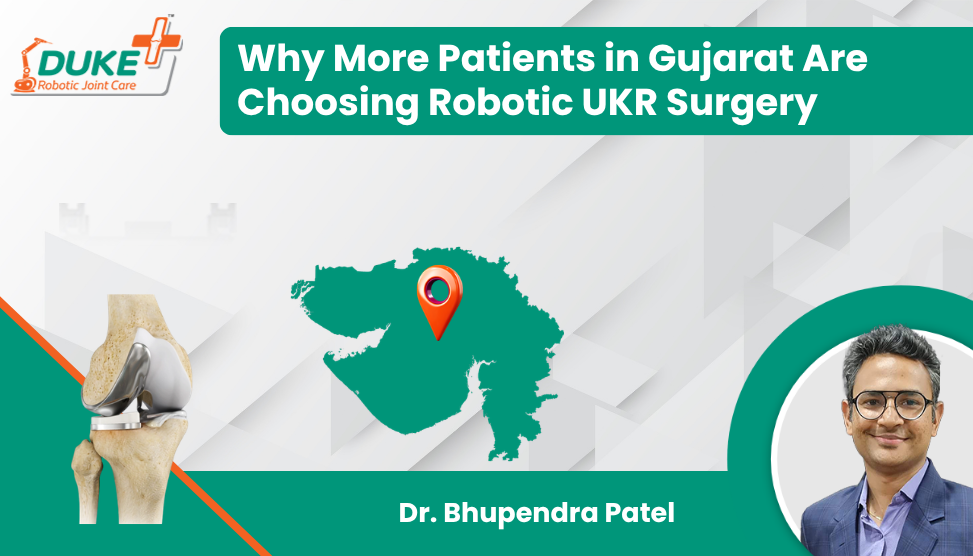
There is a growing shift toward robotic UKR surgery in Gujarat, an advanced and precise treatment designed for patients with partial knee damage.
What Is Robotic UKR Surgery?
Robotic UKR (Unicondylar Knee Replacement) is a partial knee replacement procedure where only the damaged portion of the knee is treated, while the healthy bone and ligaments are preserved.
With robotic assistance, surgeons can:
- Plan the surgery with high precision
- Achieve accurate implant positioning
- Maintain natural knee alignment
- Preserve healthy tissues and ligaments
This results in better function, faster recovery, and a more natural-feeling knee.
Understanding Knee Damage: Not Every Patient Needs Total Knee Replacement
The knee joint has multiple compartments. In many patients, arthritis affects only one part of the knee.
Instead of replacing the entire joint, robotic UKR surgery focuses only on the damaged area. This makes it a more conservative and patient-specific approach compared to total knee replacement.
Why More Patients in Gujarat Are Choosing Robotic UKR Surgery
- Higher Precision and Accuracy
Robotic technology enables surgeons to perform the procedure with sub-millimeter accuracy. This ensures better implant positioning and long-term success.
- Faster Recovery
Because less tissue is disturbed, patients often:
- Start walking early
- Recover faster
- Return to daily activities sooner
- Less Pain and Tissue Damage
The surgery targets only the affected area, reducing trauma and post-operative discomfort.
- Natural Knee Movement
Since healthy ligaments and bone are preserved, patients experience more natural movement compared to total knee replacement.
- Ideal for Active Individuals
This procedure is especially beneficial for:
- Physically active individuals
- Patients who want to return to work quickly
- Increasing Awareness in Gujarat
Patients today are more informed and actively seek advanced options like robotic partial knee replacement in Gujarat for better outcomes.
Who Is the Right Candidate for Robotic UKR Surgery?
You may be suitable if you:
- Have arthritis in only one part of the knee
- Experience localized knee pain
- Have stable ligaments
A detailed evaluation by a specialist is essential to confirm eligibility.
Robotic UKR Surgery vs Total Knee Replacement
| Factor | Robotic UKR Surgery | Total Knee Replacement |
| Bone Removal | Minimal | More extensive |
| Recovery Time | Faster | Longer |
| Pain | Less | Moderate |
| Hospital Stay | Shorter | Longer |
Patients today are not just looking for surgery—they are looking for precision, safety, and long-term mobility.
Why Choose Duke Robotic Hospital for Robotic UKR Surgery
- Advanced robotic surgical technology
- Expertise in robotic UKR and oxiplasty
- Patient-specific surgical planning
- Proven high-success outcomes
- Recognized training center for surgeons across India
The focus is not just on surgery—but on restoring confidence, mobility, and quality of life.
Key Takeaway
Knee treatment has evolved. With options like robotic UKR surgery in Gujarat, patients no longer have to undergo full joint replacement if it’s not necessary.
Choosing the right treatment at the right time can help you:
- Recover faster
- Move naturally
- Live pain-free
Consult the experts at Duke Robotic Hospital today.